When I saw the trailer for the new adaptation of Wuthering Heights, I cringed when they called it “the greatest love story” and seemed to be marketing it to a Valentine’s Day crowd. To anyone who has ever read this novel, the plot is more of a fever dream.
In the novel, Heathcliff is the mysterious child that the very stern patriarch, Mr. Earnshaw, brings into his home and favors over his own biological son, Hindley. When Mr. Earnshaw dies, there is a shift in the house where Hindley, a drunk and mentally unstable character (most notably illustrated as a core villain when he lets go of his toddler son from a second-floor bannister in a drunken rage, and Heathcliff luckily catches the child), becomes the master of the house and treats Heathcliff as a servant. Mr. Earnshaw’s daughter and Hindley’s sister, the famous Catherine, has a strong bond with Heathcliff.
That being said, Catherine is a piece of work herself. She is a feral character who has been brought up on the moors without much contact with the world beyond Wuthering Heights (the name of their estate). Her relationship with Heathcliff is unbalanced. Initially presented as a pet to her, they share the trauma of their formidable years in an extremely dysfunctional setting. When she gets injured while peeking in at her wealthy neighbor’s house (the Lintons), she is forced to stay there for five weeks to recover. During that time, she meets Edgar Linton and recognizes the benefits of wealth and status.
Although she loves Heathcliff, she loves what Edgar Linton would offer her. In another famous moment of the book, she tells the housekeeper Nelly that it would degrade her to marry Heathcliff (and of course, this is all he hears before quietly storming off, leaving for five years, and returning wealthy), but continues by then explaining how she loves Heathcliff (but goes on to marry Edgar since Heathcliff is gone). Let’s just say all of this doesn’t bode well when Heathcliff returns.
The book does not fit any traditional trope, and it doesn’t follow a traditional linear plot. It is a story within a story. A mysterious renter visits his landlord (Heathcliff) and then writes about what he learns from the housekeeper, Nelly. In the book, there actually is no physical romance between Catherine and Heathcliff. But that’s the book. Let’s look at the 2026 film adaptation.
There is no Hindley in this film. Mr. Earnshaw (the father) takes on the drunken and unstable traits of Hindley and basically beats Heathcliff from the start. Heathcliff’s origins remain true to the book: an orphaned child left on the streets who is brought home as more of a pet. A wild child herself, Catherine quickly takes to Heathcliff as they spend their time on the moors in England.
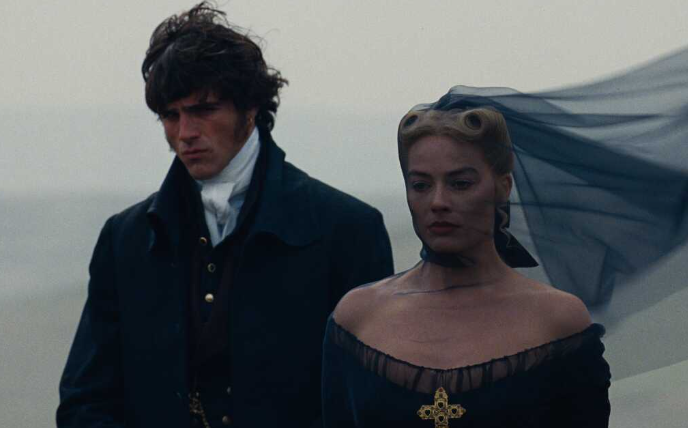
Shot on location in Yorkshire on the moors, one can understand why Emily Brontë chose this setting for her novel. The landscape is dark, empty, hazy, and phantasmagorical. This is a setting where ghosts lurk, and nightmares thrive. Amidst the black and grey tones of this backdrop, Catherine is frequently shown wearing red. In one scene, the train from her white dress flows over the cavernous landscape. The cinematography is dramatic and breathtaking.
The plot, however, strays so far from the original novel that it’s surprising they decided to keep the title. It feels more like a fan version of the story, focusing more on the return of Heathcliff (Jacob Elordi) after his 5-year hiatus to the now married Catherine (Margot Robbie). Despite the fact that this novel takes place in the late 1700s, Heathcliff and Catherine (who is pregnant in this film version) proceed to have a not-so-subtle affair in clothing that is most definitely not from the 1700s.
Are the relationships strange and toxic? Yes, but remember, this is not an adaptation of a romantic Jane Austen book; this is Emily Brontë’s magnum opus– the quintessential Gothic novel with Heathcliff as the notorious Byronic “hero.” Externally, Heathcliff (Elordi) transforms from bearded and bedraggled to clean-cut and chiseled; internally, he changes from passionate and devoted to revengeful and unscrupulous. And the romance, even in the movie, is far from how it’s advertised in the trailer (thank god). It’s toxic, weird, wrong, and shows the dangers of obsession. While all of these qualities are like the book, the movie added some off-kilter, strange scenes that helped show how evil Heathcliff was, but were unnecessary if they had just used the original scenes from the book.
While the film was beautifully shot in Yorkshire, with its foggy hills and mysterious houses, this movie clearly depicted the toxic relationship between Heathcliff and Catherine. It deviates from Brontë’s novel by focusing on sexual interactions that never actually occurred in the book. I wish they had given this movie a different title, since it strayed so far from the original plot. From a filmmaker’s point of view, the movie was visually stunning. However, from a reader’s perspective, I wouldn’t recommend seeing it if you are looking for a true adaptation of Brontë’s captivating novel.