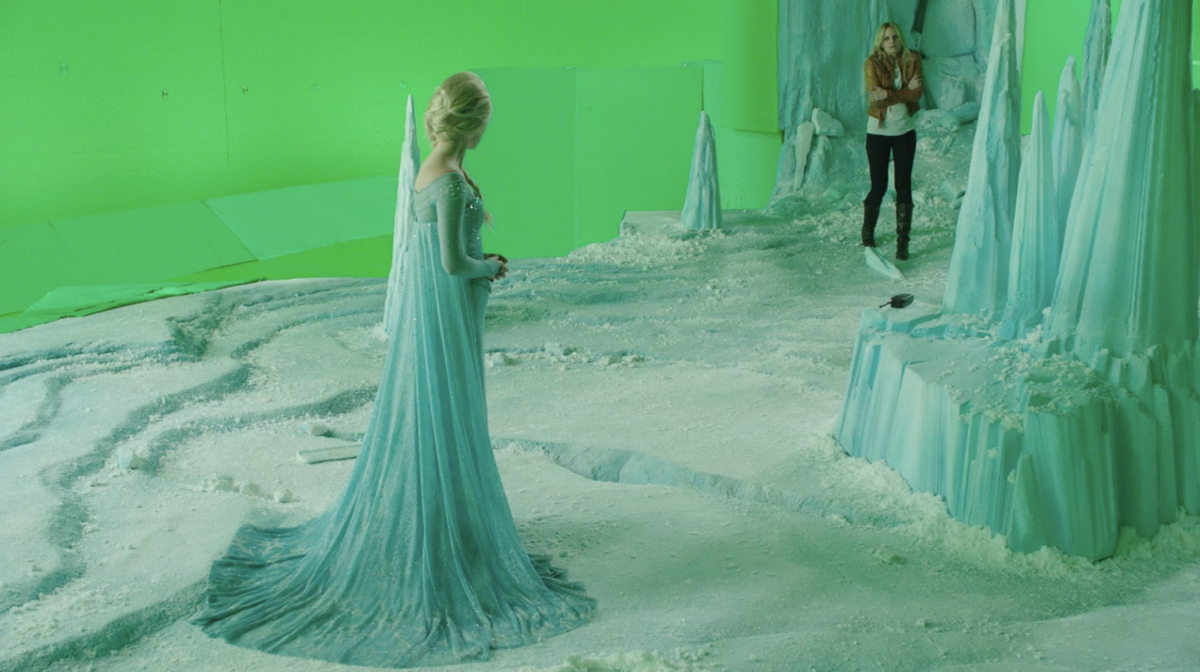
Shortly after Disney’s Frozen was released in theaters on November 27, 2013, it soon became an absolute sensation. This success led to its incorporation into other pieces of media owned by Disney, which appeared to some as a cheap way to use the Frozen name to inflate popularity. While I can not speak to all these instances, such as in Ralph Breaks the Internet or Kingdom Hearts III, for example, I do wish to analyze the Frozen crossover in the show Once Upon a Time. As a personal fan of the show, I wish to defend this crossover, as well as argue the notion that it serves as a better continuation of the original movie than the official sequel, Frozen II, released five years later. What follows will contain spoilers for both Frozen movies and a portion of Once Upon a Time.
Background
Once Upon a Time is a fantasy drama in which fairytale and Disney characters are cursed to live in modern-day (as of 2011-2018 that is) Maine. The explanation behind this curse is that it was cast by Snow White’s Evil Queen as a last attempt to enact pain and suffering on the princess. As the series went on, for a total of seven years, more and more characters from different pieces of either public domain or Disney media would end up visiting the town, usually split up into different story arcs. The Frozen arc was released in late 2014, beginning a new season. It took place directly after a Wizard of Oz storyline and directly preceding the Queens of Darkness storyline, which takes from The Little Mermaid, 101 Dalmations, and Sleeping Beauty in the form of having Ursula, Cruella de Vil, and Maleficent as antagonists. Elsa first appeared in the season three finale, No Place Like Home, as the cliffhanger, shown forming into a human shape from a blue viscous liquid poured from an urn that the show’s lead brought through a time portal from thirty years before her home dimension. Got all that? Don’t worry, there’s much more!
Plot Overview
Believe it or not, the plots of Frozen II and Once Upon a Time’s Frozen Arc are not all that dissimilar. Frozen II follows Elsa’s journey to the enchanted forest, Northuldra, where she learns that the reason her parents sailed off was to find answers about her power. Eventually, Elsa heads to the glacier, Ahtohallan, where she discovers her identity as the fifth spirit of nature. Here she also discovers her grandfather’s betrayal of the Northuldra people that led to no one being able to enter or exit the forest. In gaining this knowledge, she nearly dies before saving Arendelle from a flood and deciding to move to Northuldra. That’s a rough overview, but more people are likely to have prior knowledge of this story, and it would probably be best to leave space for Once Upon a Time’s plot overview, which will inevitably have to leave much more out.
We actually have to start a season prior, where the season three finale follows a Back to the Future-inspired two-part episode in which the main character of the show, Emma Swan, is sucked through a time travel spell to around thirty years earlier in her fairytale home dimension. When opening the portal to go back, an ornate urn is sucked through as well, later revealed to be containing Elsa. The next season opens with Elsa and Anna thirty years before preparing for Anna and Kristoff’s wedding. When looking through the attic for their mother’s wedding dress, Elsa finds their mother’s diary, which reveals that the reason the parents sailed away was to find a way to take Elsa’s powers. Anna refuses to believe this and sails to the Enchanted Forest by herself to find answers. While back at Arendelle, Elsa and Kristoff discover the urn and find inside of it another woman with ice powers. This is reviewed to be Anna and Elsa’s aunt. Betrayed by Elsa and Anna’s mother, who trapped her, she takes her anger out on Anna, trying to drive the sisters apart using a spell very reminiscent of the original Snow Queen fairytale, in which shards of a mirror piece the eyes and lead one to only see the bad in the world. The spell causes Anna to trap Elsa inside the urn, leading to the latter’s modern-day predicament.
In Maine, Elsa finds Anna’s necklace at a Pawn Shop and, convinced Anna is within the town, puts up an ice wall surrounding the perimeter that she later finds herself inexplicably unable to take down. Suddenly, a woman, Marian (Robin Hood’s Marian), keels over having been struck by ice magic. Elsa is framed for this, and we learn that her aunt, named Ingrid, has also made her way to New England. Ingrid wishes to recast her mirror spell to make everyone destroy each other, leaving only her, Elsa, and Emma. She is stopped just in time, as Elsa makes a wish on her sister’s necklace that brings Anna and Kristoff to Maine, along with a letter from the sisters’ mother apologizing for her betrayal of Ingrid. After reading this, Ingrid sacrifices herself to stop the spell.
Plot Comparison
The two plots have obvious similarities, involving an Enchanted Forest, a reason why Elsa and Anna’s parents sailed away, and an evil relative. However, I believe that Once Upon a Time is more intriguing and overall makes more sense. For one, having Anna go alone to the Enchanted Forest gives her more to do and ultimately makes her a more interesting character, whereas in Frozen II, she more or less just tags along. It also proves that, although she has no magic herself, she does not need to be barred from ever interacting with it. Frozen II’s steadfast refusal to include Anna in any magical situation where she is not being actively attacked is what I believe leads to her being much less popular. And for no good reason, as the Frozen world is rife with other forms of magic, such as the Trolls and the spirits. Furthermore, the parents being flawed in looking for a “cure” and not an “explanation” to Elsa’s powers fits better with their naive actions of locking her away in the first movie. These characters are not supposed to be noble heroes; they were led by fear into taking away their daughters’ childhoods. Elsa’s resolution is also more sensible, with her rejoining her family in Arendelle instead of running away from them again to live in the Enchanted Forest as a mystical spirit. That ending serves to make Elsa look less human, whereas Once Upon a Time portrays her as incredibly human, a well-written, three-dimensional person.
Characters
Once Upon a Time is known for taking characters from other pieces of media and changing them drastically in personality and backstory. For example, making the Evil Queen a loving mother to her adoptive son or making Captain Hook a tragic bad boy love interest. Elsa, Anna, and Kristoff were mostly spared from any major changes, but especially when compared to their Frozen II versions, there is a clear difference in their personalities. Elsa is much more openly loving to her family and less level-headed than her Frozen II counterpart. Anna is generally more grounded and gets to have her own secrets and ambitions aside from just worrying over Elsa 24/7. Kristoff gets to keep his wry wit and to have personal wants outside of just validating Anna. These changes, when compared to Frozen II, present more well-rounded characters that the audience is better able to project onto, instead of just the more basic magical ice queen, overprotective non-magical sister, and girlfriend-obsessed love interest.
Character Dynamics
These more complex personalities create more interesting relationships between the trio. To start with the sisters, Elsa’s love for Anna is more easily seen by both the lengths she goes to keep her safe– as are also seen in Frozen II— but also in the lighthearted interactions they have and the ways in which they can find understanding and community in each other. Elsa and Anna in Frozen II are almost always at odds with each other or having some huge emotional moment. We rarely get to see their dynamic in casual situations, which makes it more difficult to picture their everyday interactions as something complex, and instead, the audience defaults to their most extreme moments together: Elsa is always pushing Anna away, Anna always chasing after Elsa, as their entire, one-dimensional relationship.
Anna and Kristoff are also better in Once Upon a Time, as they retain the banter they had in the original movie, although it is more playful, with Anna being teased not as much. Kristoff also is not directly chasing her; he wants to marry her, and their wedding keeps being postponed to his chagrin, but he does not see this as a sign that they are not meant to be. He has an understanding of the situation and a knowledge of Anna that makes sense for their relationship.
Kristoff and Elsa also have a dynamic in Once Upon a Time, something that is nearly completely absent from Frozen II. They go on a mini-adventure together to find the earn, in which they slowly warm up to each other. Kristoff treats Elsa much like how he treats Anna when they first meet, teasing her jokingly and calling her out when she is wrong. Elsa, in return, sasses him back, giving us a brother-sisterly relationship that we do not get in Frozen II, where they barely interact.
Villain
Both Frozen II and Once Upon a Time decided to have Elsa and Anna’s family member as the story’s villain. Furthermore, both Ingrid and King Runeard (Elsa and Anna’s grandfather) serve as foils for Elsa. King Runeard is a ruler ruled by fear of magic, but instead of accepting it, he causes harm to others to gain more power. Ingrid grew up with ice powers that she could not accept, and instead of her sister coming back to life and loving her, she killed her one sister and trapped the other inside an urn. Ingrid is a much more interesting villain and foil, however, because– unlike Runeard– she has redeeming qualities. She may be a murderer, an attempt to kill everyone in the kingdom, but she’s tragic in a way that endears the audience to her, and she rights her wrong in the end by making the ultimate sacrifice. Her existence also doubles as an explanation for Elsa’s powers, which also serves to connect Elsa with another human and not with ancient, non-human spirits. Runeard, who does not even interact with any character during the movie, as he is dead the whole time, is just an old, bigoted man who wants more power. Granted, people like that do exist, and stories that have villains like that can also exist, but in terms of complex and interesting characters, Ingrid wins out by a landslide. She comes through much more memorably and actually affects the story as it is being shown to the viewer.
That all being said, I do not hate what is being done with the Frozen franchise. I am excited for Frozen III to come out, I really am. But I feel like the writers of these movies could learn a bit from the execution of Once Upon a Time’s Frozen Arc. I know Frozen II’s creation was rushed on time, but Once Upon a Time had literally less than a year after the first movie’s release, and had to juggle many more characters and storylines than the Frozen II team did. A main problem I think the movie’s team had that Once Upon a Time did not have was the pressure of creating the official sequel to one of the most famous movies of recent years. They might have felt a need to please everyone instead of just telling a story they wanted to tell. The concept of having this massive, awesome movie may have added unnecessary stress to the production team, whereas Once Upon a Time could more or less do what they wanted. There was still the pressure of using Disney’s precious characters, but this was not a theater-released blockbuster, and the lower stakes likely allowed them to create a product that I would deem much more enjoyable than Frozen II.