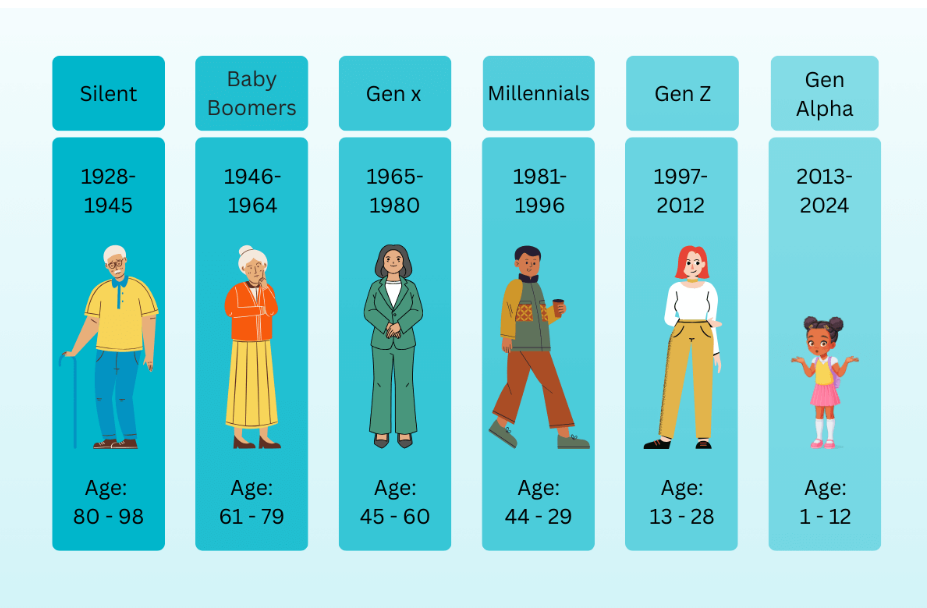
You hear these terms all the time nowadays. It’s near impossible to escape them, especially online. New trends within Gen Alpha, Gen Z slang, and millennial cringe. Generational categories such as these have wormed their way into our shared cultural zeitgeist. They make for an abundance of easy jokes poking fun at noticeable shared behaviors of different age groups, and whether you are laughing at other generations or your own, you feel a sense of belonging to your designated generational group. This is not necessarily a bad thing; humans like to be part of an in-group with a shared identity and maybe even some rivalry with out-groups — take school, city, or state pride, for example. However, when so much of the online space using these terms takes the form of short-form content that perpetuates an us versus them mentally and disregards nuance, one may start to wonder if generational identity is doing more harm than good.
A few years ago, we saw an online rivalry spring up between millennials and Generation Z. Millennials became offended that trends had changed since their youth, and Generation Z began continually mocking millennials over minor slights and “cringe”. This trend has yet to die down, as you still see stereotypical skits being posted by both generations, poking fun at the other. Millennial cringe compilations have arisen, which– if you were to ask my opinion– are in essence bullying. Liking to dance while eating or using outdated slang should not be reasons to put a target on someone’s back or be openly cruel. On the other side, millennials are older than Gen Z by definition, and seeing a bunch of over-30-year-olds spending time making unflattering generalizations about a generation who still has members in high school ultimately promotes negativity and makes those millennials look old and angry. Millennials and Gen Z are very similar in a lot of ways; both generations have been struggling in the modern economy and have been looked down on by their older generations since their respective childhood. They should not be at each other’s throats as much as they are online, but should instead work in harmony as two closely linked age groups.
Another trend regarding social media and generations was the “Okay, Boomer” trend. I have a different feeling about this trend than I do other generational divides because it is based on economic divisions and repeated disrespect. Baby boomers, most of them anyway, were privileged enough to live in a world with a booming economy, including better wage-to-cost ratios, in many things, but especially in college tuition prices and housing. Yet, despite this fact, older generations would continually mock millennials and Gen Z as lazy because of technological advancements and changes in cultural norms. “Okay, Boomer” originally started as a way to disregard opinions of a generation that most often could not speak from personal experience about trying to gain wealth in the modern economy, and yet would not stop adding their input. The backlash to “Okay, Boomer” took it as a generational divider with no context behind its origin, and boiled it down to disrespecting elders. This popular idea also became a self-fulfilling prophecy as kids heard the term and began using it solely as a means to disregard any older individual. “Okay, Boomer” should have been a phrase that highlighted the real difference between older and younger generations’ financial realities, but it was instead used as a tool for division between age groups.
The newest trend that we see in the generation wars is Gen Z versus Gen Alpha. Gen Z are now looking down their noses at Gen Alpha’s “brainrot” and slang. Not to mention the fact that a good deal of slang from both communities comes from African American Vernacular English or online incel cultures, both origins that people should be aware of when using specific words, as making jokes out of AAVE can satirize Black culture, and making humor out of incel slang can normalize harmful ideas perpetuated by those communities. But when it comes to the generational divide, Gen Z is already showing tendencies exhibited by previous generations to punch down on their younger is disheartening and useless. No amount of mockery will stop Gen Alpha from becoming the new youngest, coolest generation, just like how no amount of mockery will stop Gen Alpha from eventually being overtaken by Generation Beta when their time comes. Not being the youngest generation also does not mean that you are suddenly old and washed up, as you see suggested in some online posts. Another flaw of the generation system is that it prioritizes those at a certain age in life instead of allowing people to just appreciate every age. Gen Alpha turning into teenagers does not suddenly mean Gen Z is now “old”; they also still have their whole lives ahead of them, and it is frankly odd how much we prioritize the first 20 years of life over the rest.
Every generation has the choice to stop the cycle, and I believe, as a member of Gen Z myself, that we should make that choice and severely limit our references and cheap humor regarding the outdated and arbitrary generation system. In reality, generations are just a selection of birth years, and we should not let them dictate much more than that. Other than significant events like changes in technology, economy, etc., that would benefit from a study through a generational lens, we should not be prioritizing these terms in our assessment of ourselves and others.