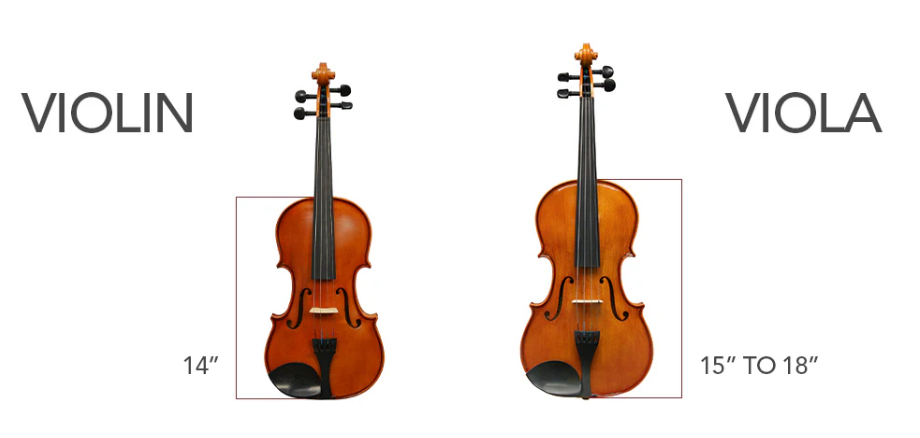
“What the heck is a viola?” is a question I get asked too often. Especially in non-musical environments, the viola is such a foreign concept to people. Oftentimes when I play in church, my instrument is mistaken for a violin and I have to explain that it’s slightly bigger. In my opinion, that’s the most simplified answer I could ever give, but there’s so much more to the difference than that. So basically, here are my go-to answers to what makes a viola a viola and a violin a violin.
Bigger:
The bottom line is that the viola is a slightly larger instrument. While the violins’ sizes go by quarters and eighths up until a full size (approx. 14 inches), violas keep going up to 16+ inches. And with size comes volume and warmth. A bigger instrument can ultimately project a larger sound, echoing more in its body. This difference in size however leads to a difference in sound and identity.
Sound:
So because of a different body, the viola has a very rich tone as well as some differences in the strings. While the violin has E, A, D, and G strings, the viola has A, D, G, and C strings. In comparison to the viola, the violin has a brighter sound and plays on a higher register. In turn, each instrument has a respective part in different ensembles that serve to create a greater overall sound. In symphonic repertoire, each instrument plays a vital part in contributing to a sound, and the roles of the violins and the violas are very distinct with violins tending to have more melodic parts and violas harmonic.
Repertoire:
While there are not nearly as many, the viola has compositions that are meant specifically for it. They still have a wide range of solo pieces like the violin including concerti and sonatas. They are included in the symphonic orchestras as well as the chamber ensembles in most cases. Composers may choose the viola to have a certain melody or piece, looking to utilize the viola’s distinctive warmth and tone.
Conclusion:
So “what the heck IS a viola”? In actuality, it is a historically crucial part of any string ensemble. It provides a depth and warmth that no other instrument can. And it is an entirely different means of sound and music from the more popular violin. But then again, the majority will never understand. For now, just know that it’s a slightly bigger violin.